

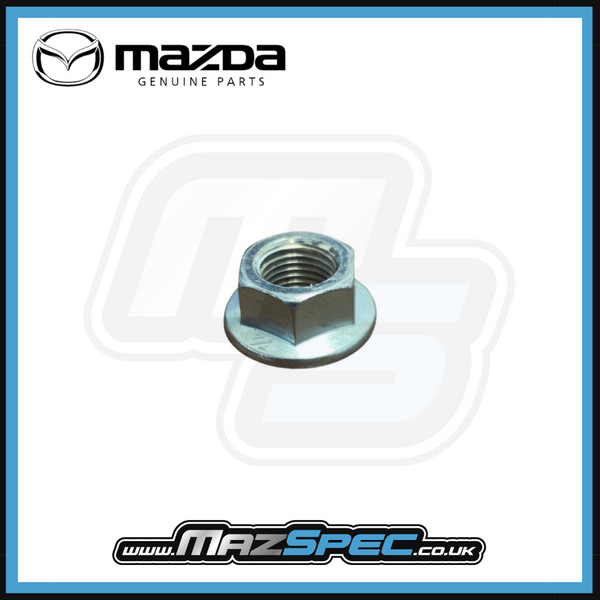
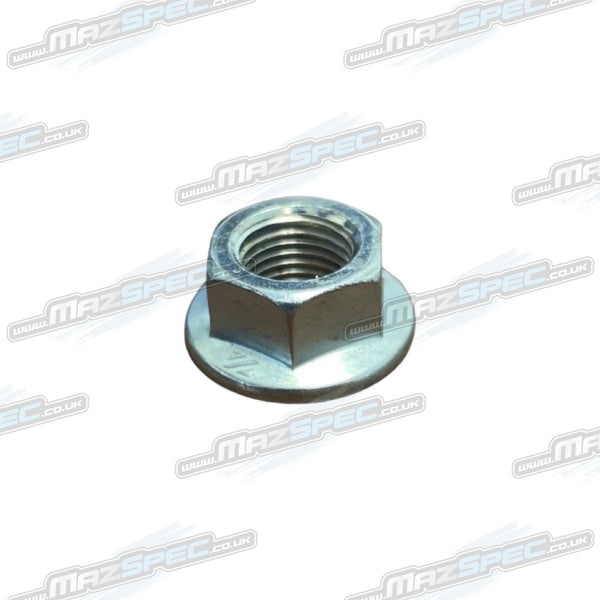
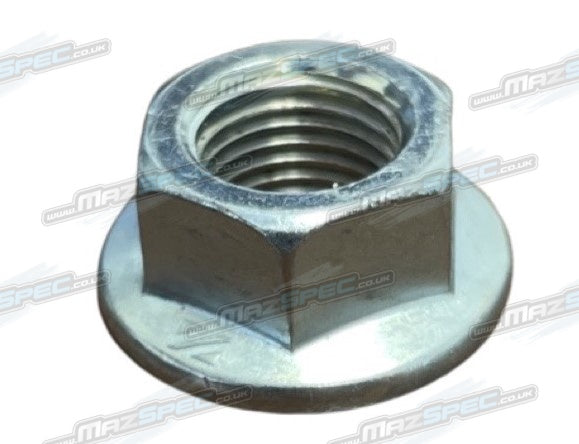
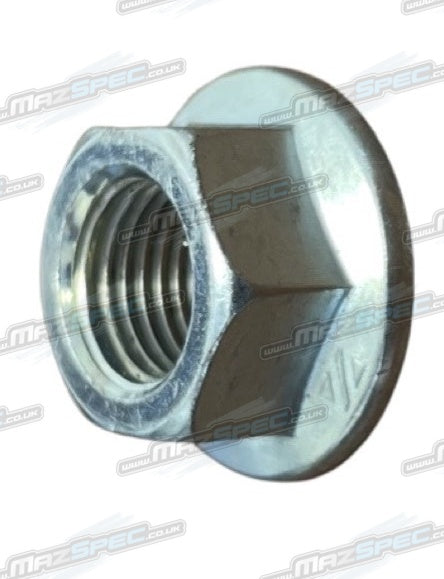




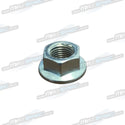
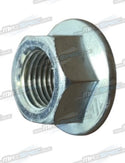
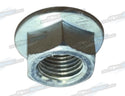






Genuine Mazda Anti-Roll Bar Drop Link & Rear Toe Arm Flange Nut
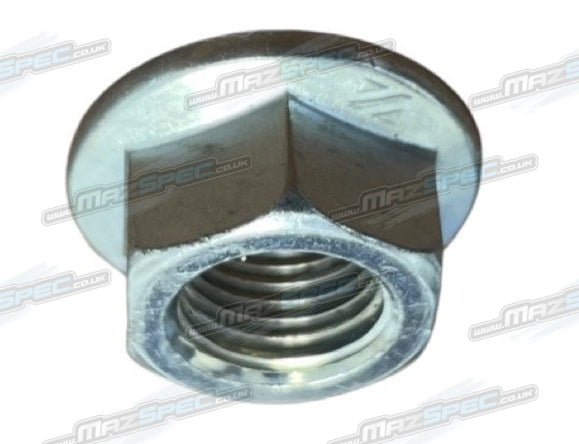
Replacement Genuine Mazda self-locking flange nut used on the anti-roll-bar drop links of Mazda MX-5 Mk2/Mk2.5 NB and Mk3/Mk3.5/Mk3.75 NC models. It is also used at the outer rear toe-control-arm connection on MX-5 NC models.
At the anti-roll-bar drop links, the nut secures the threaded drop-link stud to the anti-roll bar or corresponding suspension mounting point. Each drop link uses two nuts, with front and rear drop links fitted on both sides of the vehicle.
On the MX-5 NC, the same nut is also paired with the rear toe-control-arm pinch bolt at the outer ball-joint connection to the rear knuckle.
The integrated flange provides the correct seating area, while the self-locking feature helps resist loosening caused by suspension movement and road vibration.
This listing supplies one Genuine Mazda nut. Eight are used across the four anti-roll-bar drop links on each applicable vehicle. Two additional applications are present at the rear toe-control-arm-to-knuckle connections on the MX-5 NC.
- Part type: Self-locking flange nut
- Common names: Drop-link nut / stabiliser-link nut / suspension flange nut
- Primary application: Front and rear anti-roll-bar drop links
- Additional NC application: Rear toe-control-arm ball joint to rear knuckle
- Drop-link applications per vehicle: 8
- Additional NC rear toe-arm applications: 2
- Quantity supplied: 1 nut
- Drop link included: No
- Rear toe-control arm included: No
- Associated bolt included: No
- Brand: Genuine Mazda
- Part No.: 9994-01-001S
- Compact Mazda reference: 999401001S
- MX-5 fitment: Mk2/Mk2.5 NB and Mk3/Mk3.5/Mk3.75 NC
Typical reasons for replacement:
- Original self-locking nut removed during suspension repairs
- Locking feature weakened through previous use
- Threads damaged, corroded or cross-threaded
- Nut seized onto the drop-link or ball-joint stud
- Hexagon rounded during removal
- Flange or seating face damaged
- Anti-roll-bar drop link being replaced
- Rear NC toe-control arm being removed or renewed
- Incorrect standard nut previously installed
Quantity advice: One nut is supplied per order quantity. Eight are used across all four anti-roll-bar drop links. On NC models, two further nuts are used at the rear toe-control-arm outer connections.
Fitment advice: This is a multi-position suspension fastener. Confirm the original nut and installation position before ordering, as visually similar Mazda flange nuts are used elsewhere in the suspension.
Replacement advice: Self-locking suspension nuts should normally be renewed after removal where required by the Mazda workshop procedure. Do not substitute a conventional non-locking nut.
Thread inspection: Inspect the corresponding drop-link stud, toe-arm ball-joint stud or retaining bolt before installation. A new nut will not repair damaged or cross-threaded male threads.
Seating inspection: Clean the nut flange and adjoining mounting surface. The flange must sit squarely against the suspension component without trapped corrosion, burrs or debris.
Tightening advice: Tighten the nut using the Mazda procedure applicable to the exact installation position. Do not assume that the drop-link and rear toe-arm connections use the same tightening specification.
Other items to inspect: Check the drop-link ball joints and dust boots, anti-roll-bar bushes, corresponding suspension brackets and, on NC models, the rear toe-control-arm ball joint and pinch bolt.
Useful tools / consumables: Correct-size socket or ring spanner, hex or Torx counter-hold tool where required, breaker bar, calibrated torque wrench, penetrating fluid and suitable vehicle lifting and supporting equipment.
Difficulty guide: DIY Difficulty: Easy to Moderate. Corroded drop-link studs may rotate or seize during removal and can require additional holding or cutting tools.
Why Genuine Mazda? Genuine Mazda suspension nuts match the original thread, flange dimensions and locking specification. Correct self-locking hardware is important for maintaining secure anti-roll-bar and suspension-arm connections.
What’s in the box: One Genuine Mazda self-locking flange nut, part number 9994-01-001S.
Installation notes: Raise and support the vehicle safely where required. Clean and inspect the corresponding threads, then start the replacement nut by hand to prevent cross-threading. Counter-hold the drop-link stud where applicable and tighten the nut using the Mazda procedure for the exact installation position. Confirm that all disturbed suspension connections are secure before road use.
| Make | Model | Sub Variant | Chassis / Code | Years | Power (PS) | Engine Codes | Fuel | Transmission | Notes |
|---|---|---|---|---|---|---|---|---|---|
| Mazda | MX-5 | Mk2 / Mk2.5 NB/NB-FL – 1.6 / 1.8 / 1.8 Turbo | NB6C / NB8C | 1998–2005 | 110–185 | B6-ZE / BP-4W / BP-Z3 / BP-T | Petrol | Manual / Automatic | Used on front and rear anti-roll-bar drop-link studs; eight drop-link nut applications per vehicle; sold individually |
| Mazda | MX-5 | Mk3 NC1 – Soft Top / PRHT – 1.8 / 2.0 / 2.0 Sport | NC18 / NCEC | 2005–2009 | 126–160 | L8-DE / LF-VE | Petrol | Manual / Automatic | Used on front and rear drop links and at both outer rear toe-control-arm-to-knuckle connections; sold individually |
| Mazda | MX-5 | Mk3.5 / Mk3.75 NC2/NC3 – Soft Top / PRHT – 1.8 / 2.0 / 2.0 Sport | NC18 / NCEC | 2009–2015 | 126–160 | L8-DE / LF-VE | Petrol | Manual / Automatic | Used on front and rear drop links and at both outer rear toe-control-arm-to-knuckle connections; sold individually |
| Vehicle Manufacturer | OEM Reference Number |
|---|---|
| Mazda | 9994-01-001S |
| Mazda | 9994-01-001G |
| Mazda | 9994-01-001 |